PRP vs. Umbilical Cord-Derived Extracellular Matrix (ECM) Allograft: Why I Often Choose an Extracellular Matrix Approach for Chronic Tendon Injuries *Educational Purposes Only*
Platelet-rich plasma (PRP) has become one of the best-known regenerative treatments in orthopedics, and for good reason. It delivers a concentrated source of metabolically active platelets that release growth factors, cytokines, chemokines, and extracellular vesicles that help initiate the body's healing response.
However, most of the patients I see at RegeneZone® are not dealing with an acute injury. They have chronic tendon degeneration, partial ligament tears, longstanding plantar fasciosis, rotator cuff disease, tennis elbow, patellar tendinopathy, or chronic Achilles tendinosis. By the time they arrive in my office, the problem is often no longer simply a lack of biologic signaling—it is a loss of healthy tissue architecture.
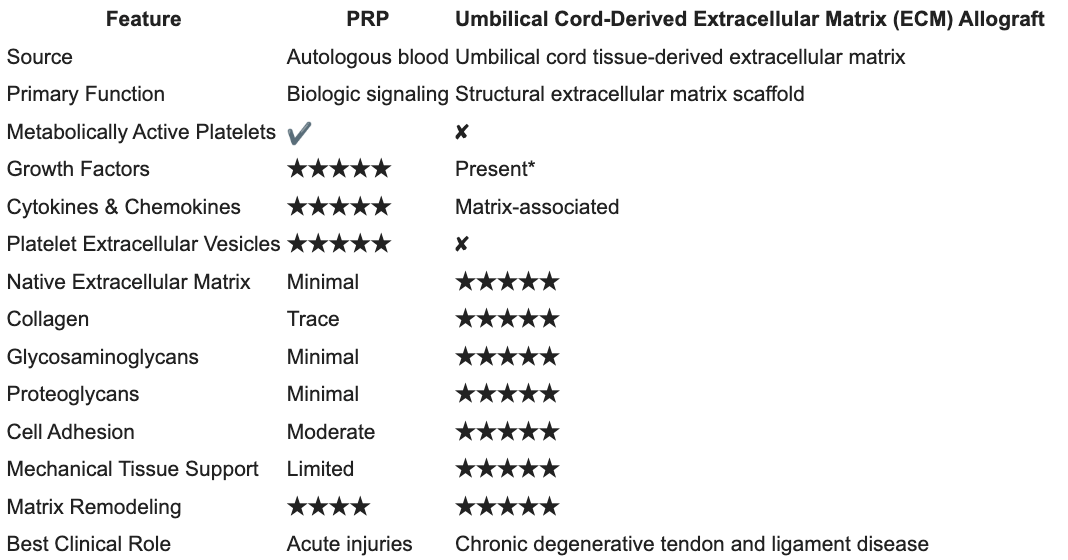
Healing requires both signals and structure. PRP primarily provides the biochemical signals that help initiate tissue repair, while an umbilical cord-derived extracellular matrix (ECM) allograft is designed to provide a collagen-rich extracellular matrix that supports cell attachment, migration, collagen organization, and long-term tissue remodeling. For many chronic tendon disorders, restoring the structural scaffold is just as important as stimulating the healing response.
Umbilical Cord-Derived Extracellular Matrix (ECM) Allograft Provides
Native collagen-rich extracellular matrix
Three-dimensional biologic scaffold
Glycosaminoglycans and proteoglycans
Adhesive matrix proteins
Matrix-associated signaling molecules
Structural support for long-term tissue remodeling
My Comprehensive Regenerative Treatment Philosophy
Because an umbilical cord-derived extracellular matrix (ECM) allograft primarily provides the structural framework for tissue repair, I build the remainder of the treatment plan around stimulating the body's own healing response and creating the ideal biologic environment for regeneration.
My comprehensive tendon protocol commonly includes:
Ultrasound-guided precision injections to accurately place the umbilical cord-derived extracellular matrix (ECM) allograft within the damaged tissue.
Photobiomodulation before and after treatment to support mitochondrial function, cellular metabolism, and tissue repair.
Focused acoustic-wave therapy following the procedure to stimulate mechanotransduction, improve local blood flow, and encourage collagen remodeling.
Progressive tendon-loading rehabilitation, one of the most powerful natural stimulators of collagen synthesis, tendon remodeling, and long-term functional recovery.
Collagen peptides with vitamin C before rehabilitation sessions to provide the amino acid building blocks necessary for new collagen formation.
Optimization of the patient's biologic environment, including adequate protein intake, vitamin D, thyroid function, hormone optimization when appropriate, metabolic health, sleep, and reduction of systemic inflammation.
Peptide therapy, including BPC-157 and thymosin-β4–based therapies, may be incorporated as part of a comprehensive regenerative treatment plan to complement the extracellular matrix by supporting the body's natural healing processes.
Lifestyle optimization, including smoking cessation, glycemic control, weight management, and individualized rehabilitation to maximize long-term healing.
Rather than relying on a single injection, my goal is to create the ideal biologic environment for regeneration. The procedure itself is only one component of a comprehensive strategy designed to optimize the body's ability to rebuild healthy tendon and ligament tissue.
The Bottom Line
PRP and umbilical cord-derived extracellular matrix (ECM) allografts should not be viewed as competing therapies—they address different aspects of tissue healing.
PRP primarily provides biologic signaling, while an umbilical cord-derived extracellular matrix (ECM) allograft primarily provides structural support.
For acute injuries, PRP remains an excellent option. For the chronic degenerative tendon and ligament disorders that I treat most frequently, I often prefer to restore the tissue's structural framework with an umbilical cord-derived extracellular matrix (ECM) allograft while supporting the healing process through ultrasound-guided treatment, photobiomodulation, acoustic-wave therapy, progressive rehabilitation, peptide therapy when appropriate, nutritional optimization, and correction of the underlying biologic factors that influence healing.
This comprehensive approach reflects how I practice regenerative medicine—not simply injecting a product, but creating the optimal environment for the body to repair itself.
The presence of specific growth factors in umbilical cord-derived extracellular matrix (ECM) allografts is based on manufacturer characterization of the extracellular matrix. Direct quantitative comparisons with PRP and head-to-head randomized clinical trials remain limited.