The RegeneZone® Regenerative Ladder *Educational Purposes Only*
A Progressive Approach to Regenerative Orthopedics
At RegeneZone®, we do not believe every joint, tendon, or ligament problem should be treated with the same injection. Regenerative medicine works best when the treatment matches the biology, severity, and structural needs of the tissue.
That is why we developed the RegeneZone® Regenerative Ladder—a progressive framework that allows us to move from foundational biologic stimulation to increasingly advanced regenerative strategies based on the individual patient.
The concept is simple: the greater the tissue degeneration, the more regenerative support may be required.
The Regenerative Ladder
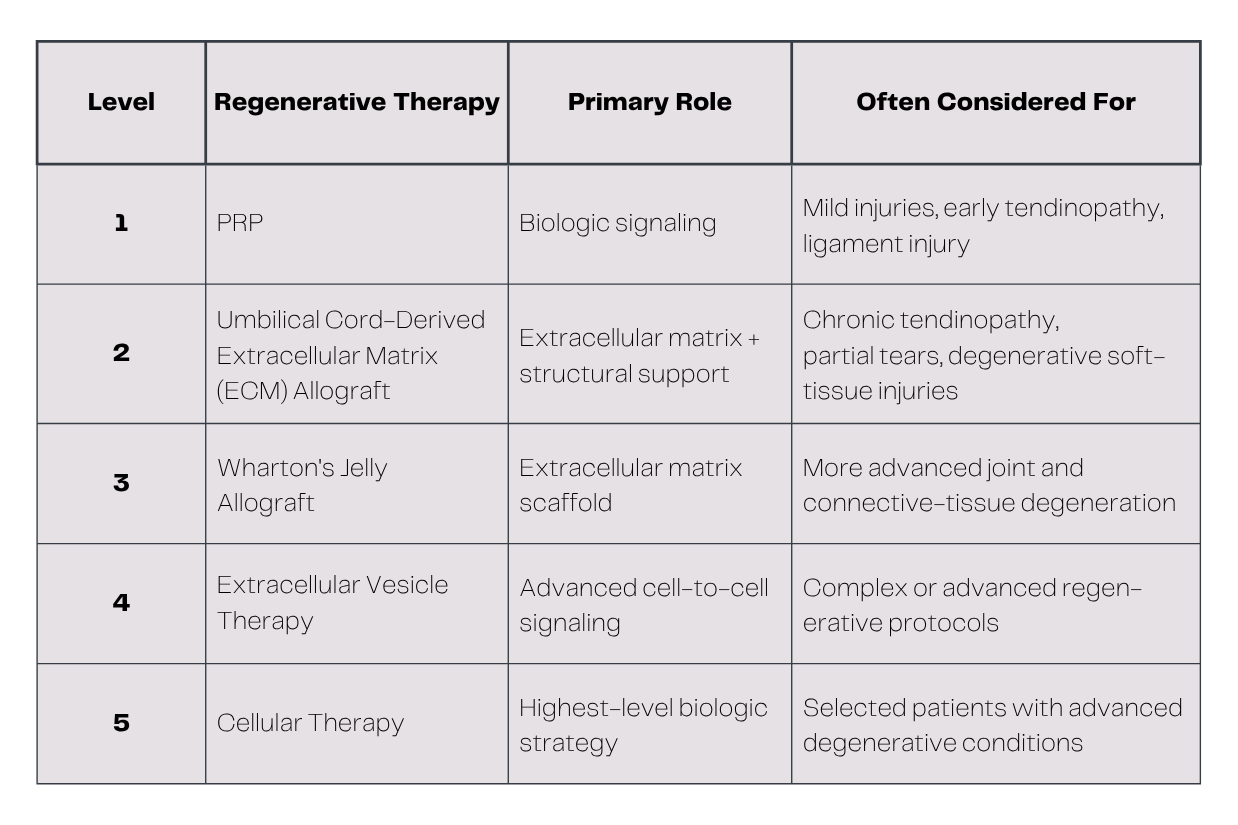
LEVEL 1 — PRP
Activate the Healing Response
Platelet-rich plasma uses a concentrated portion of the patient's own blood containing platelets and plasma-associated signaling molecules.
Once activated, platelets release growth factors, cytokines, chemokines, and other mediators involved in the body's natural healing response.
We may use PRP for earlier-stage tendon, ligament, muscle, and joint conditions, particularly when the underlying tissue architecture remains relatively intact.
Primary objective: SIGNAL
LEVEL 2 — UMBILICAL CORD-DERIVED EXTRACELLULAR MATRIX ALLOGRAFT
Provide Signals + Structure
As an injury becomes chronic, the problem may no longer be simply inadequate biologic signaling. Years of degeneration can alter the extracellular matrix—the structural environment surrounding the body's cells.
For these patients, we may use an umbilical cord-derived extracellular matrix (ECM) allograft designed to provide a collagen-rich extracellular matrix.
This is an important distinction from PRP. PRP primarily provides a concentrated source of platelet-derived signaling. An ECM allograft provides a structural extracellular matrix environment that may be particularly relevant when treating chronically damaged tendons, ligaments, and other connective tissues.
This is why we frequently consider an ECM approach for chronic Achilles tendinopathy, plantar fasciosis, rotator cuff disease, tennis elbow, patellar tendinopathy, partial ligament injuries, and other longstanding degenerative conditions.
Primary objective: SIGNAL + STRUCTURE
LEVEL 3 — WHARTON'S JELLY ALLOGRAFT
Build the Scaffold
With more advanced degeneration, we may progress further up the Regenerative Ladder to a Wharton's jelly-derived connective tissue allograft.
Wharton's jelly contains a naturally occurring extracellular matrix rich in structural components, including collagen, proteoglycans, and glycosaminoglycans.
Rather than viewing these treatments simply as "stronger injections," we think about what the damaged tissue is missing. In more significantly compromised tissue, providing an extracellular matrix scaffold may become increasingly important.
We commonly consider this level for osteoarthritis and more advanced degenerative joint or connective-tissue conditions.
Primary objective: SCAFFOLD
LEVEL 4 — EXTRACELLULAR VESICLE THERAPY
Amplify Cellular Communication
Extracellular vesicles are microscopic membrane-bound particles involved in communication between cells. They can carry proteins, lipids, nucleic acids, and other biologically active molecules from one cell to another.
Within selected RegeneZone® protocols, extracellular vesicle products may be incorporated as part of a broader regenerative strategy designed around the biologic environment of the injured tissue.
The goal is not simply to inject another product. It is to create a more comprehensive regenerative environment combining signaling with structural support when appropriate.
Primary objective: COMMUNICATION
LEVEL 5 — CELLULAR THERAPY
Advanced Regenerative Potential
At the top of the Regenerative Ladder are cellular approaches reserved for carefully selected patients and clinical circumstances.
These strategies represent a fundamentally different level of regenerative medicine and require careful consideration of the cell source, processing, regulatory status, tissue characteristics, patient selection, and available clinical evidence.
For appropriate patients, cellular therapies may be considered when significant degeneration requires a more advanced biologic strategy than lower levels of the ladder can provide.
Primary objective: REGENERATIVE POTENTIAL
It Is Not Always About Climbing Higher
One of the most important principles of the RegeneZone® Regenerative Ladder is that higher does not automatically mean better.
A patient with a relatively healthy tendon and a new injury may respond beautifully to PRP. A patient with years of chronic tendon degeneration may need greater extracellular matrix support. Someone with advanced osteoarthritis may require an entirely different strategy.
The goal is not to sell the most advanced treatment.
The goal is to identify the appropriate rung of the ladder for the tissue in front of us.
More Than an Injection
Regenerative medicine at RegeneZone® extends beyond the procedure itself. Depending on the patient, we may integrate regenerative injections with diagnostic musculoskeletal ultrasound, photobiomodulation, acoustic wave therapy, rehabilitation, nutritional optimization, peptide-based strategies, hormone optimization, and systemic approaches to inflammation and metabolic health.
Every musculoskeletal injection is performed with ultrasound guidance, allowing us to visualize the anatomy and precisely target the injured structure.
This creates a comprehensive approach built around three fundamental questions:
What signals does the tissue need?
What structural support does the tissue need?
What environment does the body need to heal?
That is the philosophy behind the RegeneZone® Regenerative Ladder.
SIGNAL → STRUCTURE → SCAFFOLD → COMMUNICATION → REGENERATIVE POTENTIAL
RegeneZone®
Advanced Regenerative Orthopedics. Precision. Biology. Restoration.