Biologic Therapies for Knee Osteoarthritis: What the Latest Research Tells Us About Joint Preservation *Educational Purposes Only*
By Dr. John A. Robinson, NMD & Dr. Cristina Romero-Bosch, NMD | RegeneZone™
For decades, osteoarthritis was explained to patients as a simple problem of wear and tear: cartilage gradually deteriorates, the joint becomes painful, and eventually the available choices narrow to medications, injections and joint replacement. We believe that model is increasingly outdated.
A major 2026 review published in Cureus, “Biologic Therapies for Knee Osteoarthritis: A Structured Narrative Review of Joint Preservation Strategies and Clinical Outcomes,” brings together contemporary research on platelet-rich plasma (PRP), mesenchymal stromal cell (MSC)-based therapies, bone marrow aspirate concentrate (BMAC), microfragmented adipose tissue (MFAT), stromal vascular fraction (SVF) and other emerging orthobiologic approaches. The review evaluated 32 clinically relevant publications, including randomized trials, systematic reviews, meta-analyses and prospective studies.
What interests us most about this paper isn't simply which injection performed best. It is the larger biological story it tells about osteoarthritis and where regenerative medicine may be heading.
Osteoarthritis Is More Than Worn-Out Cartilage
One of the most important shifts in our understanding of osteoarthritis is recognizing that it is a whole-joint biological disease, not merely cartilage being mechanically worn away.
The disease involves cartilage, synovium, subchondral bone, menisci, ligaments and surrounding tissues. Persistent low-grade inflammation can contribute to extracellular-matrix degradation, oxidative stress, cellular senescence and impaired repair. Inflammatory cytokines and matrix metalloproteinases can create a progressively catabolic environment inside the joint.
This matters because it fundamentally changes how we think about treatment.
Instead of asking only, “How do we replace damaged cartilage?”, we should also be asking:
How can we create a healthier biological environment in which the joint can function, repair and preserve itself?
That question is central to our approach at RegeneZone.
What Orthobiologics May Actually Be Doing

PRP, MSC-based therapies and other orthobiologics are sometimes described as if their primary purpose were simply to “regrow” damaged tissue. The biology appears considerably more sophisticated.
The review describes orthobiologics as therapies capable of influencing the balance between anabolic and catabolic signaling within the joint. PRP delivers growth factors and other signaling molecules, while MSC-based therapies appear to work largely through paracrine and immunomodulatory mechanisms. MSCs release cytokines, growth factors, anti-inflammatory mediators and extracellular vesicles that may influence macrophage behavior, inflammatory signaling and endogenous repair.
This is an important distinction. The contemporary model is increasingly:
Change the environment → reduce destructive signaling → support endogenous repair → preserve remaining joint tissue.
That is very different from the simplistic idea that injected cells merely become new cartilage.
PRP: The Most Established Orthobiologic
Among the treatments evaluated, PRP currently has the largest body of clinical evidence.
The review found that PRP can improve pain and patient-reported function, particularly in people with mild-to-moderate knee osteoarthritis. Several studies found more durable symptomatic benefits compared with hyaluronic acid or corticosteroid injections, although results vary substantially depending upon PRP formulation, treatment protocol and patient characteristics.
The details may matter considerably. One randomized study found that multiple PRP injections produced more sustained improvement than a single injection, although five treatments did not clearly outperform three. Another review suggested that higher platelet doses may be associated with greater clinical response, but an optimal platelet threshold has not yet been established.
This helps explain why saying someone “received PRP” tells us surprisingly little. Platelet concentration, leukocyte content, preparation method, injection schedule, disease severity and the patient's underlying biology may all influence the outcome.
MSC-Based Therapies: Promising, but More Complex
Mesenchymal stromal cell-based therapies are particularly interesting because of their ability to influence inflammation, tissue homeostasis and repair signaling.
Bone-marrow-derived, adipose-derived and umbilical-cord-derived MSCs have all been studied. Clinical trials have demonstrated improvements in pain and function, and some have reported favorable MRI findings or other preliminary structural changes. However, the authors appropriately emphasize that these findings do not yet prove reliable restoration of normal articular cartilage.
There are nevertheless intriguing signals. A small trial involving bone-marrow-derived MSCs reported sustained clinical improvement at 48 months. A randomized study of umbilical-cord-derived MSCs found that repeated administration produced more durable improvement than a single administration. Adipose-derived MSC studies have likewise produced symptomatic improvements accompanied by preliminary structural signals.
The research therefore suggests biological potential while simultaneously reminding us not to equate symptomatic improvement—or even an interesting MRI—with proven cartilage regeneration.
More Complex Doesn't Necessarily Mean Better
BMAC contains a mixture of progenitor cells, hematopoietic cells, platelets, cytokines and growth factors. That biological complexity is appealing, but an important lesson from this review is that more biologically complex does not automatically mean more clinically effective.
In a randomized trial comparing BMAC with PRP, both produced comparable improvements at 12 months. Similarly, randomized comparisons involving MFAT and PRP have reported comparable improvements despite substantial differences between the products.
Orthobiologic Approaches Discussed in the Review
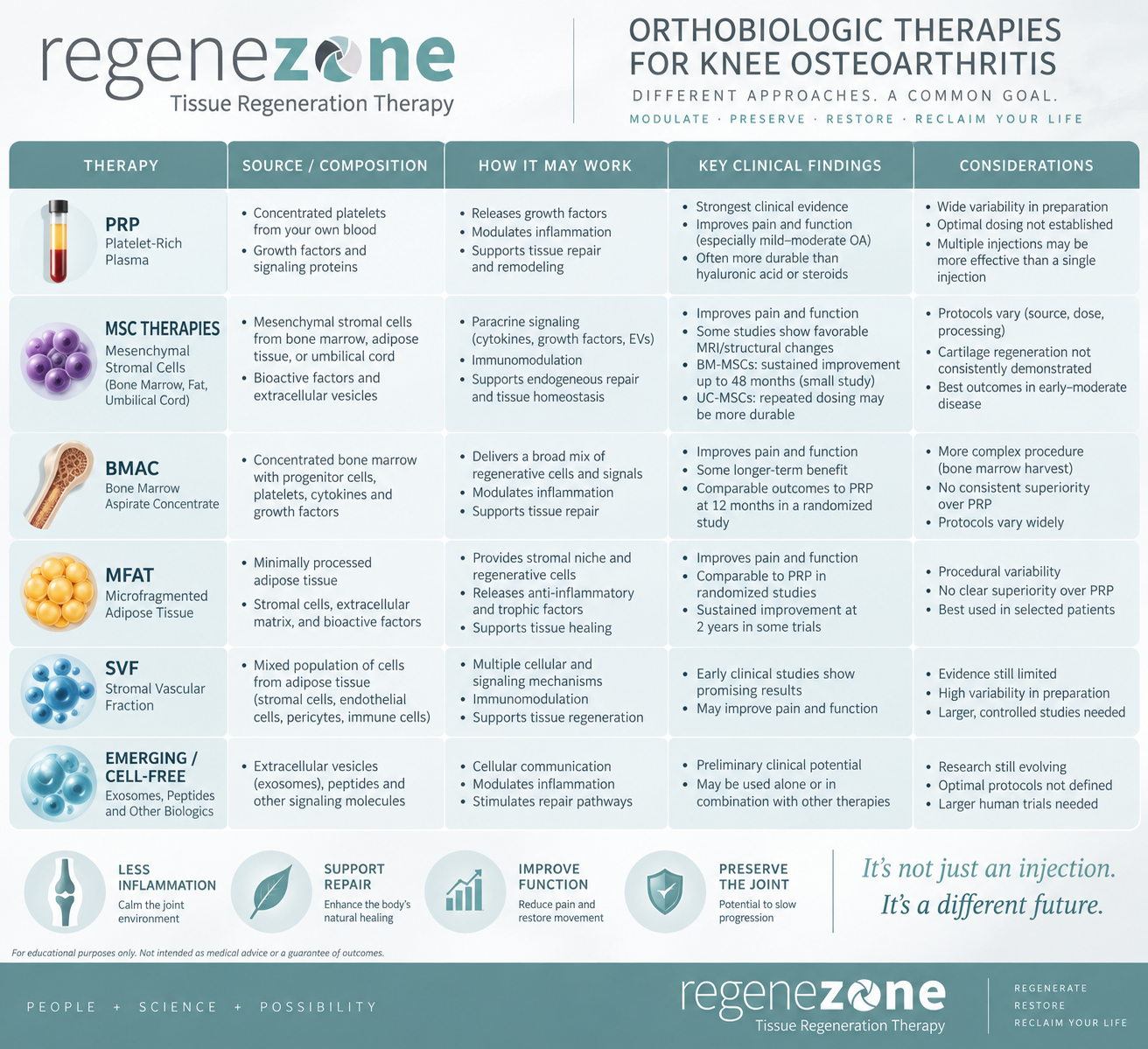
The table reflects the review's synthesis rather than a ranking of treatments.
The Patient May Matter as Much as the Product
Perhaps one of the most clinically important findings is that outcomes appear better in early-to-moderate osteoarthritis, when there is still meaningful “joint reserve.”
A severely mechanically compromised joint with extensive tissue destruction presents a very different biological problem than an earlier-stage joint with viable cartilage and a more favorable mechanical environment. The review specifically notes that better outcomes with MSC therapies have been observed in early-to-moderate disease.
One study combining adipose-derived MSCs with high tibial osteotomy is especially illustrative: outcomes appeared to depend upon both cellular characteristics and biomechanical correction. Biology and mechanics are interconnected.
Why This Fits the RegeneZone Philosophy
This research reinforces something we believe strongly at RegeneZone: the injection should not be viewed as the entire treatment.
If osteoarthritis exists within an inflammatory, metabolic and mechanically compromised environment, it makes little sense to focus exclusively on what is placed into the joint. Our protocols therefore consider the broader biological terrain. We evaluate systemic inflammatory biomarkers and may incorporate individualized nutritional, phytochemical, hormonal and peptide strategies intended to address the patient's overall inflammatory and metabolic environment alongside appropriate regenerative procedures.
We also consider biomechanics, muscle function and rehabilitation because regenerative signaling cannot be separated completely from the mechanical environment in which a joint operates.
The goal is not simply to inject a product. It is to create the most favorable environment possible for joint preservation, function and endogenous repair.
A New Model of Regenerative Medicine
Perhaps the biggest lesson from this review is that regenerative medicine is evolving beyond the idea of finding a single “best” injection.
The authors conclude that PRP, MSC-based therapies and BMAC can produce meaningful improvements in pain and function in appropriately selected patients, while emphasizing that definitive long-term structural modification remains uncertain. They position these interventions as components of individualized joint-preservation strategies rather than replacements for established surgical treatments.
We think that is the appropriate way to understand the field.
The future of regenerative orthopedics may ultimately be less about what we inject and increasingly about understanding whom we treat, when we treat them, the condition of the joint, the inflammatory environment surrounding it, the mechanical forces acting upon it, and how different biological signals can be intelligently combined.
That is a much more sophisticated vision of regenerative medicine—and one that moves us from simply treating pain toward the larger goal of preserving the joint itself.
For educational purposes only. This information is not intended as medical advice or as a guarantee of outcomes from any regenerative or orthobiologic therapy.