Extracellular Vesicles and Osteoarthritis: Can We Change the Conversation Inside an Arthritic Joint? *Educational Purposes Only*
By Dr. John A. Robinson, NMD & Dr. Cristina Romero-Bosch, NMD | RegeneZone™
For years, we have told our patients that osteoarthritis is much more complicated than simply having a joint that has “worn out.” Cartilage loss is certainly part of the disease, but modern research increasingly shows that osteoarthritis involves the entire joint—cartilage, synovium, subchondral bone, immune cells, fat, blood vessels, nerves, cellular aging, metabolism, and the body's own repair mechanisms.
A fascinating 2026 review in Frontiers in Immunology, “Mammalian cell-derived extracellular vesicles remodel the immune-repair microenvironment in osteoarthritis: from pathological signal transmission to regenerative therapy,” takes this concept even further. The researchers describe osteoarthritis as a disease in which tissues throughout the joint are constantly communicating with one another, and tiny particles called extracellular vesicles, or EVs, appear to be important messengers within that communication system.
For us, this research suggests an important way of thinking about regenerative medicine: an arthritic joint doesn't just contain damaged tissue. It may also be receiving biological signals that perpetuate that damage.
Osteoarthritis Is a Whole-Joint Disease
The traditional explanation of osteoarthritis focuses heavily on cartilage. Over time, cartilage deteriorates, the joint space narrows, pain develops, and eventually the joint may need to be replaced.
We now know the biology is considerably more complicated.
Cartilage damage can activate inflammatory processes within the synovium, or joint lining. The synovium then releases inflammatory signals that can further damage cartilage. At the same time, changes are occurring in the bone beneath the cartilage, immune cells, fat pad, blood vessels and surrounding tissues. These different tissues influence one another and can create a cycle of inflammation and tissue breakdown.
This helps explain why osteoarthritis isn't always predictable. Two people with similar X-rays can experience very different symptoms and rates of progression.
The health of the joint is about much more than how much cartilage remains.
Extracellular Vesicles: How Cells Communicate
Extracellular vesicles are tiny membrane-covered particles released by cells. They can carry proteins, lipids, messenger RNA, microRNA and other biological information from one cell to another.
One useful way to think about EVs is as biological messages. A cell releases an EV containing information, another cell receives it, and that information may influence how the receiving cell behaves.
But EVs are not automatically beneficial.
EVs produced by healthy or therapeutically useful cells may carry very different information from those released by stressed, inflamed or aging cells. Their biological effects depend upon where they came from, the condition of the cells producing them, what they contain and the condition of the tissue receiving them.
This distinction is important because EVs appear to participate in both the progression of osteoarthritis and potentially its treatment.
The Pathological EV Cycle
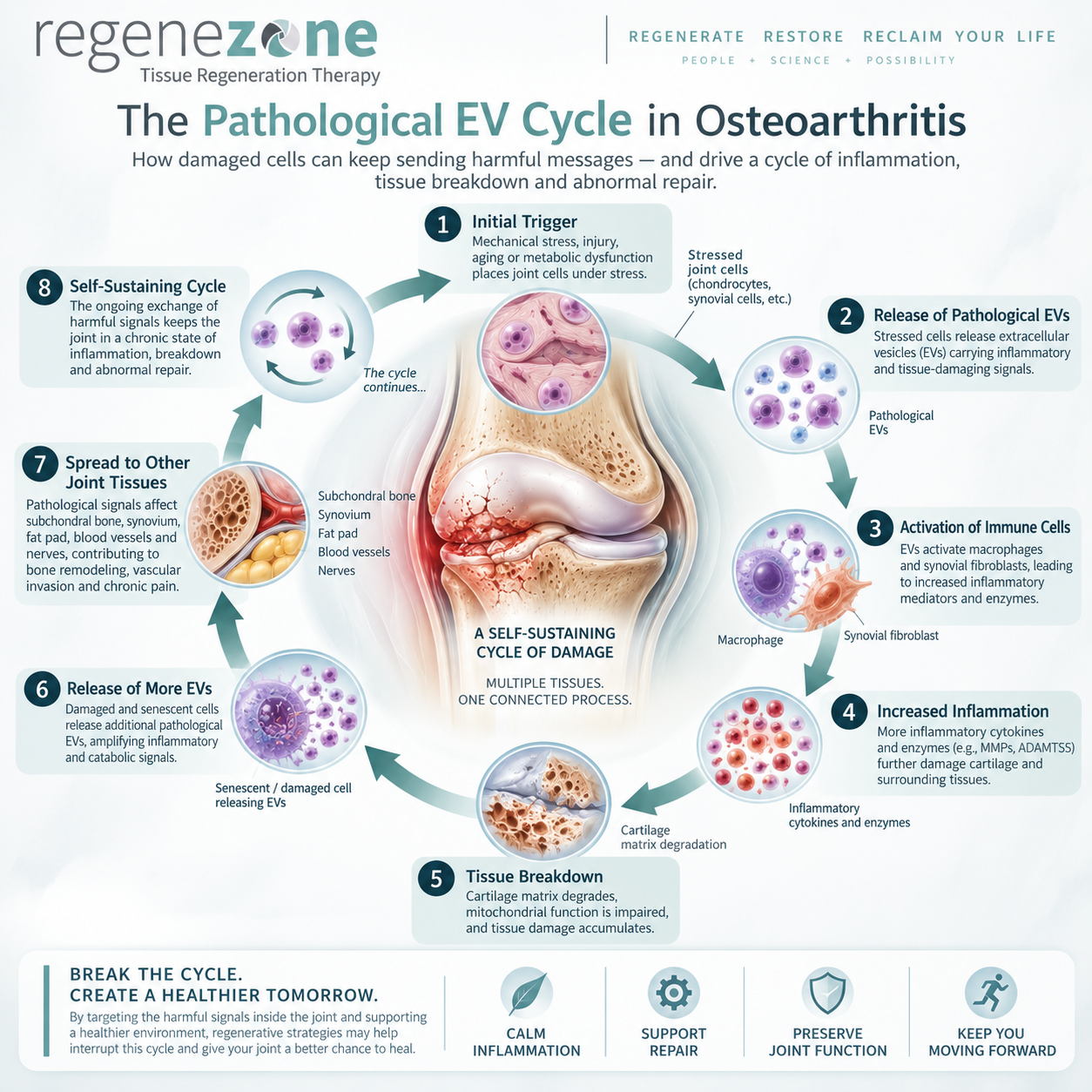
One of the most interesting concepts in this review is what the researchers describe as a pathological EV cycle.
Mechanical injury, aging or metabolic dysfunction can place cells within the joint under stress. Those cells may begin releasing EVs containing inflammatory or tissue-damaging signals. These signals can activate immune cells and synovial fibroblasts, which then release additional inflammatory mediators, enzymes and EVs.
Inflammation begins affecting the health of cartilage cells, including their mitochondrial function and their ability to maintain the surrounding cartilage matrix. As cartilage breaks down, additional signals are released that further stimulate inflammation.
The cycle can eventually begin reinforcing itself.
The authors illustrate this on page 7 of the paper as a repeating interaction between inflammation, mitochondrial dysfunction, cartilage-matrix degradation and abnormal repair.
This is important because it changes the therapeutic question. Instead of focusing exclusively on damaged cartilage, we can begin asking whether the biological environment driving continued damage can also be changed.
Can Therapeutic EVs Change Those Signals?
This is where the research becomes particularly interesting for regenerative medicine.
Extracellular vesicles derived from mesenchymal stromal cells and other therapeutic cell populations appear, primarily in preclinical studies, to carry signals capable of influencing the joint environment in a very different direction.
Research reviewed in the paper suggests therapeutic EVs may help regulate excessive inflammation, influence macrophage activity, improve mitochondrial function and cellular cleanup mechanisms, decrease certain forms of cell death and cellular senescence, and support healthier cartilage metabolism.
Rather than simply supplying a new substance to the joint, EVs may therefore act in part by changing the behavior of cells already present within the joint.
That distinction is important.
From Suppressing Inflammation to Supporting Repair
Inflammation is not inherently harmful. A normal inflammatory response is part of how the body responds to injury, removes damaged tissue and begins repair.
The problem occurs when inflammation fails to resolve.
The authors introduce the concept of “regenerative immunity.” Instead of simply shutting down the immune response, the goal would be to help immune cells move from a prolonged tissue-damaging state toward one that clears debris, resolves inflammation and supports tissue reconstruction.
The paper's diagram on page 9 highlights three major areas through which therapeutic EVs may influence this process: modifying macrophage activity, reducing abnormal inflammatory and metabolic signaling, and addressing the environment created by senescent cells. Together, these effects could potentially create a joint environment that is more favorable for repair.
Cellular Aging Is Part of the Story
Another important component of osteoarthritis is cellular senescence.
Senescent cells are damaged or aging cells that no longer behave normally. They can remain within tissues and release inflammatory molecules and other signals that negatively influence neighboring cells. Over time, this can contribute to a local environment that makes normal repair increasingly difficult.
The review discusses experimental evidence suggesting therapeutic EVs may reduce some of these senescence-associated signals, improve the function of stressed cells that retain repair potential, and influence the inflammatory environment surrounding them.
This is an emerging area of research, but it further demonstrates why osteoarthritis cannot be understood simply by looking at an X-ray and measuring cartilage loss.
Does This Mean EVs Regrow Cartilage?
Not yet—and this distinction is critical.
Improving inflammation, supporting healthier cartilage cells or increasing cartilage-matrix production is not the same as demonstrating regeneration of normal articular cartilage.
The authors emphasize that true cartilage regeneration would require restoration of appropriate cartilage-cell function, extracellular-matrix composition, collagen organization and long-term mechanical properties.
There are also significant challenges with EV research and clinical translation. EV products can differ substantially depending upon their cellular source and manufacturing process. Researchers have not yet established uniform methods for isolation, dosing, potency testing or long-term safety evaluation.
The science is exciting, but we need to be precise about what has—and has not—been demonstrated.
Why This Matters at RegeneZone
This research reinforces an important part of our philosophy at RegeneZone: the injection is only one component of a regenerative protocol.
If osteoarthritis involves inflammation, cellular health, metabolism, biomechanics and impaired repair signaling, then simply injecting something into a joint without considering the environment surrounding that joint may miss an important part of the problem.
That is why our protocols look more broadly at the patient. Depending upon the individual situation, we may evaluate inflammatory biomarkers and consider nutritional, phytochemical, hormonal and peptide strategies alongside appropriate image-guided regenerative procedures. We also consider muscle function and biomechanics because the biological environment and mechanical environment of a joint cannot be completely separated.
The emerging science surrounding extracellular vesicles gives us another way to understand this approach.
The future of regenerative orthopedics may not simply be about asking what we can put into a damaged joint. It may also be about understanding the signals already circulating within that joint and finding better ways to shift the environment away from chronic inflammation and tissue breakdown and toward resolution, preservation and repair.
In that sense, regenerative medicine may increasingly become about not only treating the damaged tissue, but changing the biological conversation around it.
For educational purposes only. This article discusses emerging research and is not intended as medical advice or as a claim that extracellular-vesicle therapies have been established to regenerate human knee cartilage or modify osteoarthritis progression.