Can We Actually Restore Cartilage? What New MRI Research Tells Us About Osteoarthritis *Educational Purposes Only*
For decades, the conventional story of osteoarthritis has been relatively simple: cartilage deteriorates, the joint becomes painful, and eventually we manage symptoms until the patient requires joint replacement.
Regenerative medicine research is challenging that narrative.
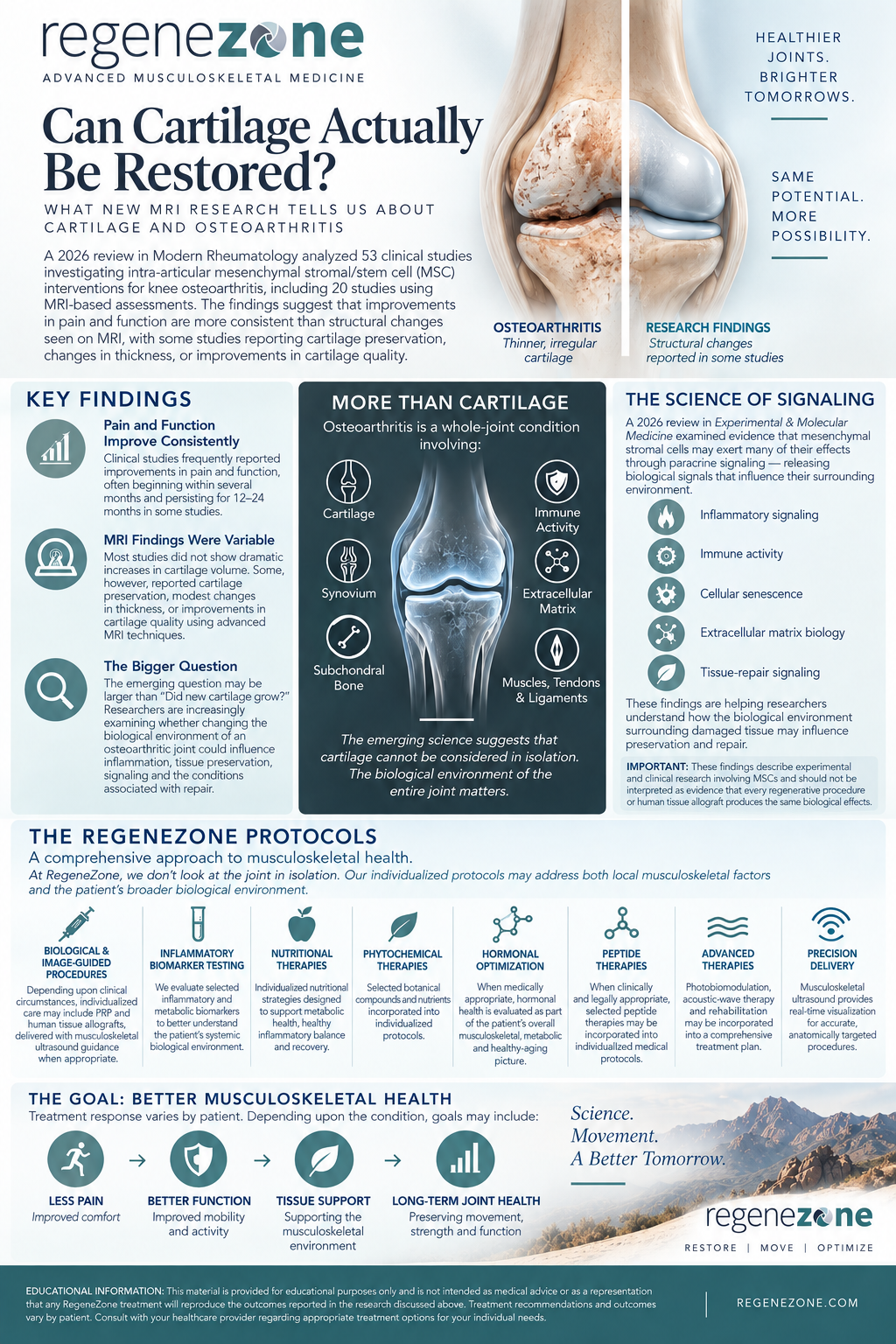
A 2026 review published in Modern Rheumatology, “Potential for Cartilage Restoration in Osteoarthritis Patients Through Intra-Articular Injection of Mesenchymal Stem Cells,” examined whether patients simply felt better following investigational mesenchymal stromal/stem cell (MSC) interventions—or whether researchers could actually identify changes in cartilage on MRI.
The findings are encouraging, although considerably more nuanced than saying regenerative therapies simply “regrow cartilage.”
Looking Beyond Pain Relief
Researchers reviewed 53 clinical studies evaluating intra-articular MSC interventions for knee osteoarthritis and cartilage lesions. Twenty included MRI-based cartilage assessments.
Patients frequently experienced improvements in pain and function, sometimes persisting for 12 to 24 months. MRI findings were more variable. Most studies did not demonstrate dramatic increases in cartilage volume, but some reported cartilage preservation, increased thickness or improvements in cartilage quality.
This changes the scientific question from simply, “Did we grow new cartilage?” to something potentially more important: “Did we change the biological environment enough to influence degeneration, tissue preservation and repair?”
That broader biological perspective also informs how we evaluate osteoarthritis at RegeneZone.
Importantly, these studies evaluated specific MSC interventions in research settings. They should not be interpreted as evidence that other biologic procedures or human tissue allografts produce the same cellular, signaling or structural effects.
Osteoarthritis Is a Biological Environment
An arthritic knee isn't simply a mechanical hinge with a worn-out cushion. It is a living biological environment involving cartilage, synovium, subchondral bone, extracellular matrix, inflammatory signaling, immune activity and the surrounding muscles, tendons and ligaments.
Another 2026 review published in Experimental & Molecular Medicine, part of the Nature portfolio, examined next-generation cell therapies for osteoarthritis. The authors emphasized that much of the potential therapeutic activity associated with mesenchymal stromal cells may arise through paracrine signaling, rather than simply from implanted cells physically becoming new cartilage.
Researchers are investigating how these signals may influence inflammation, immune activity, cellular senescence, extracellular matrix biology and pathways associated with tissue repair.
This represents an important evolution in regenerative medicine research. Scientists are increasingly asking whether changing the signaling and biological environment surrounding damaged tissue can create conditions more favorable to preservation and repair.
The RegeneZone Protocols: Looking Beyond the Joint
This broader concept is fundamental to our RegeneZone protocols.
We don't believe the environment inside an arthritic joint can be completely separated from the systemic environment of the patient. Musculoskeletal tissues exist within a larger biological system, which is why we evaluate factors that may influence inflammation, metabolism, recovery and overall tissue health.
Our protocols can include tracking selected inflammatory and metabolic biomarkers in the blood rather than focusing exclusively on imaging and symptoms.
When appropriate, we may incorporate nutritional, phytochemical, hormonal and other individualized medical therapies designed to support metabolic health, healthy inflammatory balance and recovery.
This is an important distinction in the RegeneZone approach. We don't simply look at the joint; our protocols consider the broader biological environment surrounding musculoskeletal health and recovery.
What Does the MRI Actually Show?
MRI allows researchers to distinguish symptom improvement from structural change. Pain can improve without cartilage becoming thicker, while slowing cartilage loss could potentially be meaningful even without dramatic cartilage regrowth.
Some studies in the Modern Rheumatology review showed little measurable structural change, while others reported cartilage preservation, increased thickness or improved cartilage characteristics. Advanced MRI techniques such as T2 mapping are particularly interesting because they can evaluate aspects of cartilage composition and organization that conventional MRI may not adequately capture.
We may ultimately discover that cartilage quality and preservation can be as important as cartilage quantity.
Building a Comprehensive Musculoskeletal Protocol
This research reinforces an important point: treating osteoarthritis should involve considerably more than deciding what to inject into a painful knee.
Depending upon the patient's condition and pathology, RegeneZone protocols may incorporate platelet-rich plasma (PRP), human tissue allografts when clinically appropriate, photobiomodulation, acoustic-wave therapy and rehabilitation, alongside nutritional, phytochemical, hormonal and other individualized medical therapies.
The human tissue allografts used in clinical practice are distinct from the MSC interventions evaluated in these studies, and MSC research should not be interpreted as evidence that an allograft produces the same cellular, signaling or cartilage-related effects.
We also use musculoskeletal ultrasound guidance for image-guided procedures, allowing us to visualize anatomy in real time and accurately target the appropriate anatomical structure.
Our goal isn't simply to inject something into a painful area. Our protocols are designed to understand the pathology, evaluate relevant local and systemic factors, improve function and create a more favorable overall environment for musculoskeletal recovery.
What Does “Regeneration” Really Mean?
Perhaps one of the most important lessons from this research is that regeneration should not be treated as a single clinical endpoint.
Researchers may measure pain reduction, functional improvement, stabilization of structural deterioration, preservation of existing cartilage, changes in tissue quality or—in some investigational settings—evidence suggesting structural repair.
Those outcomes aren't interchangeable. A patient can experience substantial improvement without measurable cartilage regrowth, while stabilization of cartilage loss could potentially represent a meaningful structural finding.
The research therefore supports thinking about outcomes along a continuum:
Symptom improvement → Functional improvement → Tissue preservation → Investigational evidence of structural change
Evidence of structural change reported in MSC research should not be interpreted as an expected outcome from RegeneZone procedures or human tissue allografts.
Changing the Conversation Around Osteoarthritis
The Modern Rheumatology review does not establish that intra-articular MSC interventions reliably regenerate substantial amounts of human articular cartilage. The MRI evidence remains variable.
But considered alongside the 2026 Experimental & Molecular Medicine review, the research raises a larger concept: the biological environment of an osteoarthritic joint matters.
Instead of thinking exclusively about controlling pain until a joint eventually needs replacement, we can ask:
How can we address systemic and local factors associated with inflammation, function and musculoskeletal health while using appropriate therapies to support recovery and long-term joint function?
That question is central to the RegeneZone approach. Our protocols combine diagnosis, imaging, laboratory assessment and individualized medical and procedural therapies rather than viewing osteoarthritis simply as an isolated cartilage problem.
The future may increasingly involve understanding the biological environment—systemically and locally—and determining how best to preserve mobility, function and musculoskeletal health for as long as possible.
Research
Jacob G, Shimomura K, Akimori T, et al. Potential for cartilage restoration in osteoarthritis patients through intra-articular injection of mesenchymal stem cells: an MRI-based morphological evaluation of repair cartilage: A narrative review. Modern Rheumatology. 2026. DOI: 10.1093/mr/roag061.
Peitso V, Ellis R, Ng K, et al. Next-generation therapies for osteoarthritis: the evolving role of cell therapy products. Experimental & Molecular Medicine. 2026;58:1754–1771.