The Case for Young, Donor-Derived Placental Tissue in Regenerative Medicine *Educational Purposes Only*
Why the Biological Age of Donated Tissue May Matter More Than Using Your Own Cells
RegeneZone™ | The Science of Regenerative Medicine
The Biological Age of Your Cells Matters
When patients consider regenerative medicine for osteoarthritis, joint degeneration, or chronic musculoskeletal injuries, an important question arises: Are their own cells necessarily the best biological source for supporting tissue repair?
Autologous regenerative procedures use biological material harvested from a patient's own bone marrow or adipose tissue. While this approach offers advantages, including avoiding donor-cell immune incompatibility, it raises a fundamental question.
If your joints have aged, your cartilage has deteriorated, and your body has experienced decades of inflammation and oxidative stress, haven't your own regenerative cells been exposed to those same conditions?
Research demonstrates that mesenchymal stromal cells (MSCs), like other cells throughout the body, undergo age-related changes that may influence their biological performance.
This has generated growing interest in young, healthy perinatal donor-derived tissues, including placental and umbilical cord tissues, as alternative sources of regenerative biological materials.
The premise is straightforward: Younger tissue may provide a more favorable biological starting point than tissue harvested from an older individual experiencing degenerative disease.
Your Regenerative Cells Age Along With You
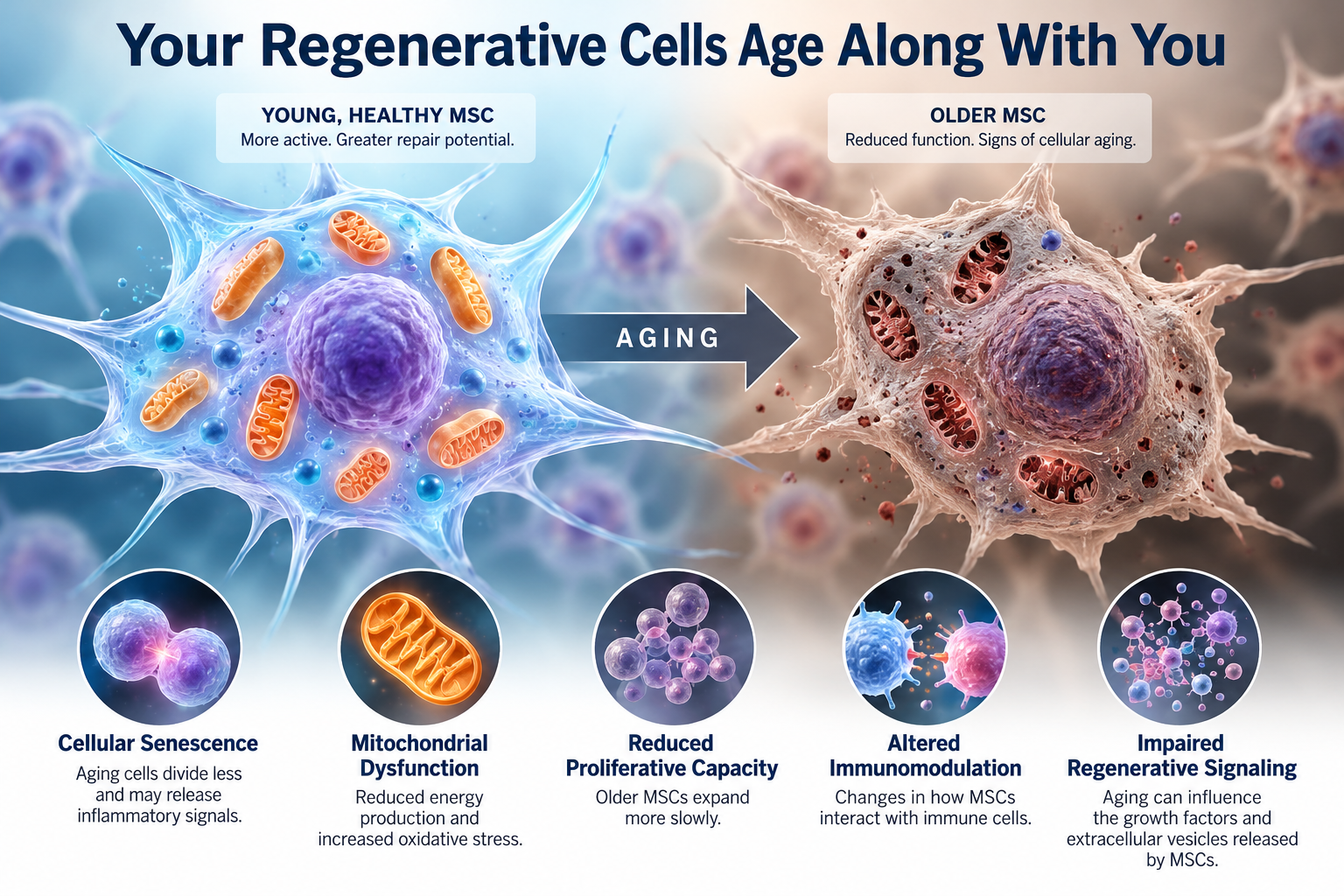
MSCs participate in tissue maintenance through cellular communication, immunomodulation, and the release of biologically active signaling molecules. However, their capabilities may decline with age.
Research has identified several important mechanisms:
Cellular senescence: Aging cells may lose their ability to divide normally and can release inflammatory signaling molecules.
Mitochondrial dysfunction: Declining mitochondrial performance can compromise cellular energy production and increase oxidative stress.
Reduced proliferative capacity: MSCs from older donors frequently demonstrate diminished expansion potential.
Altered immunomodulation: Chronic inflammation may change how MSCs interact with immune cells.
Impaired regenerative signaling: Aging can influence the growth factors and extracellular vesicles released by MSCs.
These changes are particularly relevant in osteoarthritis, where chronic inflammation, cartilage deterioration, and altered cellular metabolism create an environment that challenges natural tissue maintenance.
An older patient still possesses MSCs, but those cells may no longer demonstrate the biological characteristics they possessed decades earlier.
Using your own cells does not automatically mean using your most biologically capable cells.
Mitochondria: A Critical Factor in Regenerative Potential
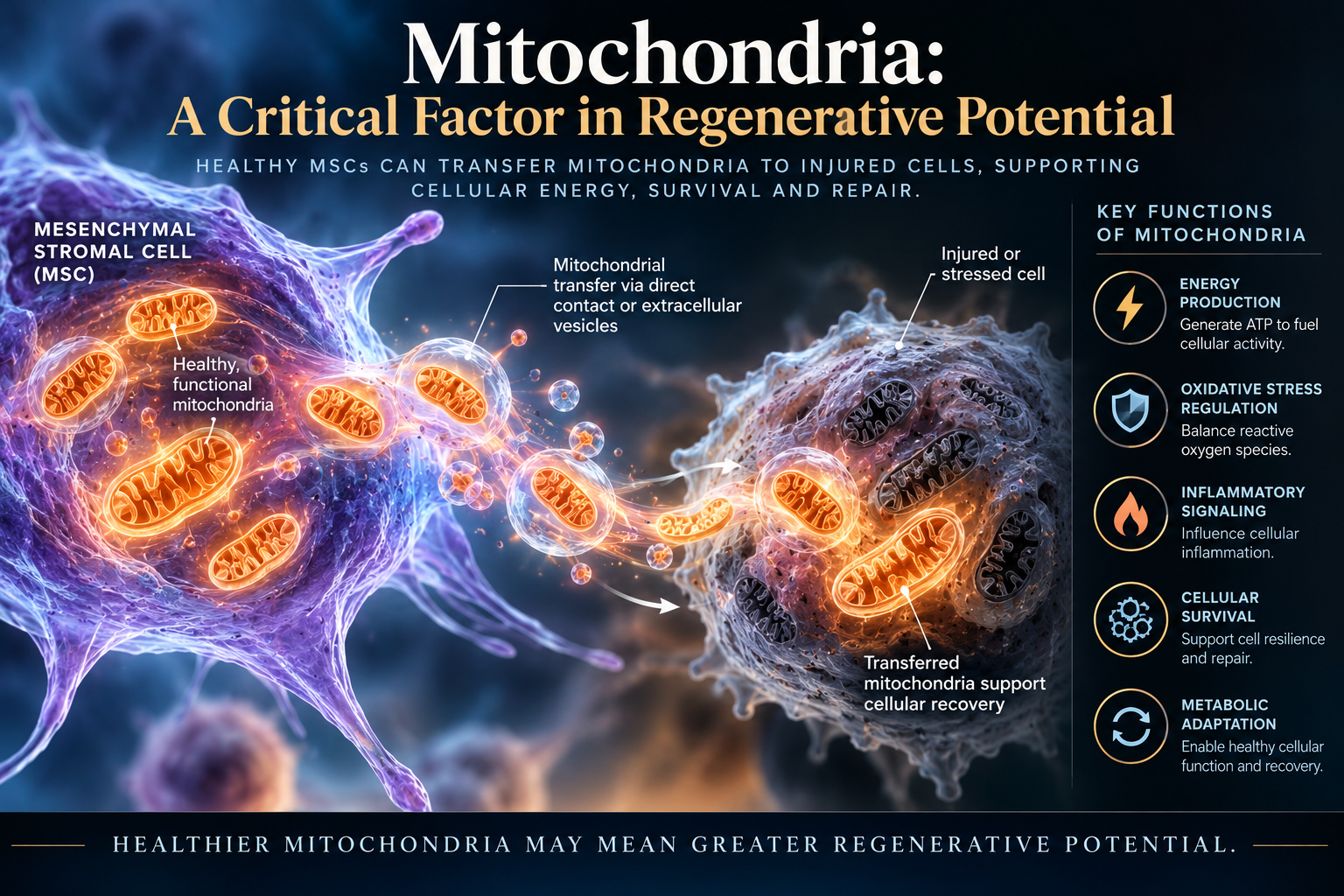
Mitochondria do far more than produce cellular energy. They regulate oxidative stress, inflammatory signaling, cellular survival, and metabolic adaptation.
Research has demonstrated that MSCs can transfer mitochondria or mitochondrial components to injured cells under experimental conditions. This process has attracted attention because it suggests that MSCs may influence tissue recovery through mechanisms beyond traditional growth-factor signaling.
This raises an important question:
If an older patient's MSCs have accumulated mitochondrial dysfunction, could their ability to support damaged tissues also be compromised?
The hypothesis is biologically plausible, although mitochondrial transfer has not been established as a clinically effective mechanism for treating osteoarthritis.
Research examining mitochondrial characteristics in MSCs from osteoarthritis patients and healthy donors reinforces the importance of investigating cellular metabolic health.
The emerging principle is that regenerative potential may depend not simply on cell numbers, but on the functional quality of those cells.
Why Young Placental and Umbilical Cord Tissue Is Different
Placental and umbilical cord tissues are collected at birth, before decades of exposure to aging-related biological stress.
MSCs isolated from perinatal tissues frequently demonstrate several favorable characteristics in laboratory investigations:
Greater proliferative potential. Perinatal MSCs often expand more readily than cells obtained from older adults.
Lower cellular senescence. Their biological youth may be associated with fewer markers of accumulated cellular aging.
Potentially favorable mitochondrial function. Young MSC populations may demonstrate advantageous metabolic characteristics, depending on tissue source and processing.
Immunomodulatory activity. Perinatal MSCs can influence inflammatory signaling and immune-cell behavior in experimental systems.
Regenerative signaling. These cells can release extracellular vesicles, growth factors, and other molecules involved in cellular communication.
These characteristics make perinatal tissues scientifically interesting, particularly when compared with biological material harvested from older individuals.
However, placental and umbilical cord tissues contain distinct cell populations and extracellular matrix components. Their biological properties are not interchangeable, and laboratory advantages do not automatically translate into superior clinical outcomes.
The Osteoarthritis Paradox: Aging Cells Treating Aging Joints
Osteoarthritis involves cartilage deterioration, subchondral bone changes, synovial inflammation, and impaired tissue homeostasis. Aging is one of its strongest risk factors.
Consider a 70-year-old patient with advanced knee osteoarthritis undergoing an autologous regenerative procedure.
Biological material is harvested from the patient's own bone marrow or adipose tissue and introduced into the affected joint.
Yet those cells have aged within the same organism experiencing joint degeneration, chronic inflammation, and metabolic changes.
This creates an important scientific question:
Is biological material from an older patient with degenerative disease the most favorable option, or might healthy tissue collected at birth provide advantages?
Autologous cell-based approaches have shown encouraging findings in some clinical investigations, and donor-derived materials have their own limitations and risks.
Nevertheless, donor age and cellular health deserve consideration when evaluating regenerative potential.
Young perinatal tissues may offer an alternative biological starting point that avoids some of the cellular limitations associated with aging.
Whether this translates into better clinical outcomes remains to be demonstrated.
Not All Donor-Derived Allografts Are Equivalent
The potential advantages of young donor tissue do not mean every placental or umbilical cord allograft possesses identical biological properties.
Living MSC preparations, extracellular matrix allografts, and extracellular vesicle products are fundamentally different materials.
A processed allograft does not necessarily contain viable MSCs, even when the original tissue contained them. Processing, preservation, and storage can substantially alter the final product's cellular composition and biological activity.
Likewise, extracellular vesicles are not living stem cells, although they may contain biologically active signaling molecules.
The biological age of the donor is important, but so are the quality, composition, and processing of the finished product.
Claims of clinical benefit require appropriate evidence. In the United States, MSC and extracellular vesicle products are not FDA-approved for treating osteoarthritis, and donor-derived tissue products intended for joint regeneration may require additional regulatory authorization.
A Different Philosophy of Regenerative Medicine
At RegeneZone™, we believe regenerative medicine must move beyond the assumption that more cells automatically produce better outcomes.
The biological age, metabolic health, mitochondrial function, and signaling characteristics of cells and tissues deserve careful scientific consideration.
Young perinatal donor-derived tissues are particularly interesting because they originate from a biological environment fundamentally different from that of an older patient experiencing chronic degenerative disease.
This does not establish that donor-derived allografts are clinically superior to autologous approaches. Rather, it highlights the importance of investigating the quality of biological materials, not simply their quantity or origin.
The future of regenerative medicine will depend on connecting these biological principles with rigorous product characterization, clinical evidence, and appropriate regulatory standards.
The Future of Regeneration May Begin With Younger Biology
Aging affects more than our joints, muscles, and connective tissues. It also influences the cells responsible for maintaining those structures.
The same processes contributing to cartilage degeneration, mitochondrial dysfunction, and chronic inflammation can compromise the biological systems involved in tissue repair.
Young, healthy perinatal donor-derived tissues may offer a more favorable starting biological profile, particularly regarding cellular senescence, mitochondrial health, and regenerative signaling.
Whether those advantages can be preserved through manufacturing and translated into meaningful clinical benefits remains an important area of investigation.
Perhaps the future of regenerative medicine is not simply about finding ways to stimulate older cells to repair damaged tissue.
Perhaps it is also about understanding whether younger biological materials can provide a better foundation for regeneration.
That is the scientific case for continued investigation of young, donor-derived placental and umbilical cord tissues.
Scientific References
Characterization of the Mitochondrial Genome Landscape in MSCs, iPSCs and iMSCs from Osteoarthritis Patients and Healthy Donors. PubMed.
Stolzing A, Jones E, McGonagle D, Scutt A. Age-related changes in human bone marrow-derived mesenchymal stem cells: consequences for cell therapies. Mechanisms of Ageing and Development. 2008;129(3):163–173. https://doi.org/10.1016/j.mad.2007.12.002
Phinney DG, Pittenger MF. Concise Review: MSC-Derived Exosomes for Cell-Free Therapy. Stem Cells. 2017;35(4):851–858. https://doi.org/10.1002/stem.2575
Wang Y, Chen X, Cao W, Shi Y. Plasticity of mesenchymal stem cells in immunomodulation: pathological and therapeutic implications. Nature Immunology. 2014;15:1009–1016. https://doi.org/10.1038/ni.3002
U.S. Food and Drug Administration. Consumer Alert on Regenerative Medicine Products Including Stem Cells and Exosomes.
Medical disclaimer: This article discusses emerging research and does not establish the safety, efficacy, or clinical superiority of any particular allograft or cell-derived product for osteoarthritis.