A New Way to Control Pain Without Blocking the Healing Response *Educational Purposes Only*
Pain control presents an interesting challenge in regenerative medicine.
When we perform a regenerative procedure, our goal is not simply to make an injured joint, tendon, or ligament feel better temporarily. We are attempting to create an environment that supports the body's natural repair processes. That means we have to think carefully not only about what we inject, but also about what medications we use before and after the procedure.
For years, medications such as ibuprofen, naproxen, and other nonsteroidal anti-inflammatory drugs (NSAIDs) have been among the most common ways of treating musculoskeletal pain. They work largely by inhibiting cyclooxygenase enzymes—COX-1 and/or COX-2—and reducing the production of prostaglandins involved in inflammation and pain.
That can be very effective for pain.
But inflammation is also part of healing.
Following tissue injury, inflammatory signaling participates in vascular changes, cellular recruitment, immune signaling, and the complex sequence of events involved in tissue repair. This is one reason we generally try to minimize unnecessary NSAID exposure around many regenerative procedures.
The question then becomes: Can we reduce pain without suppressing the inflammatory pathways we may want to preserve?
A new class of pain medication may allow us to approach that problem very differently.
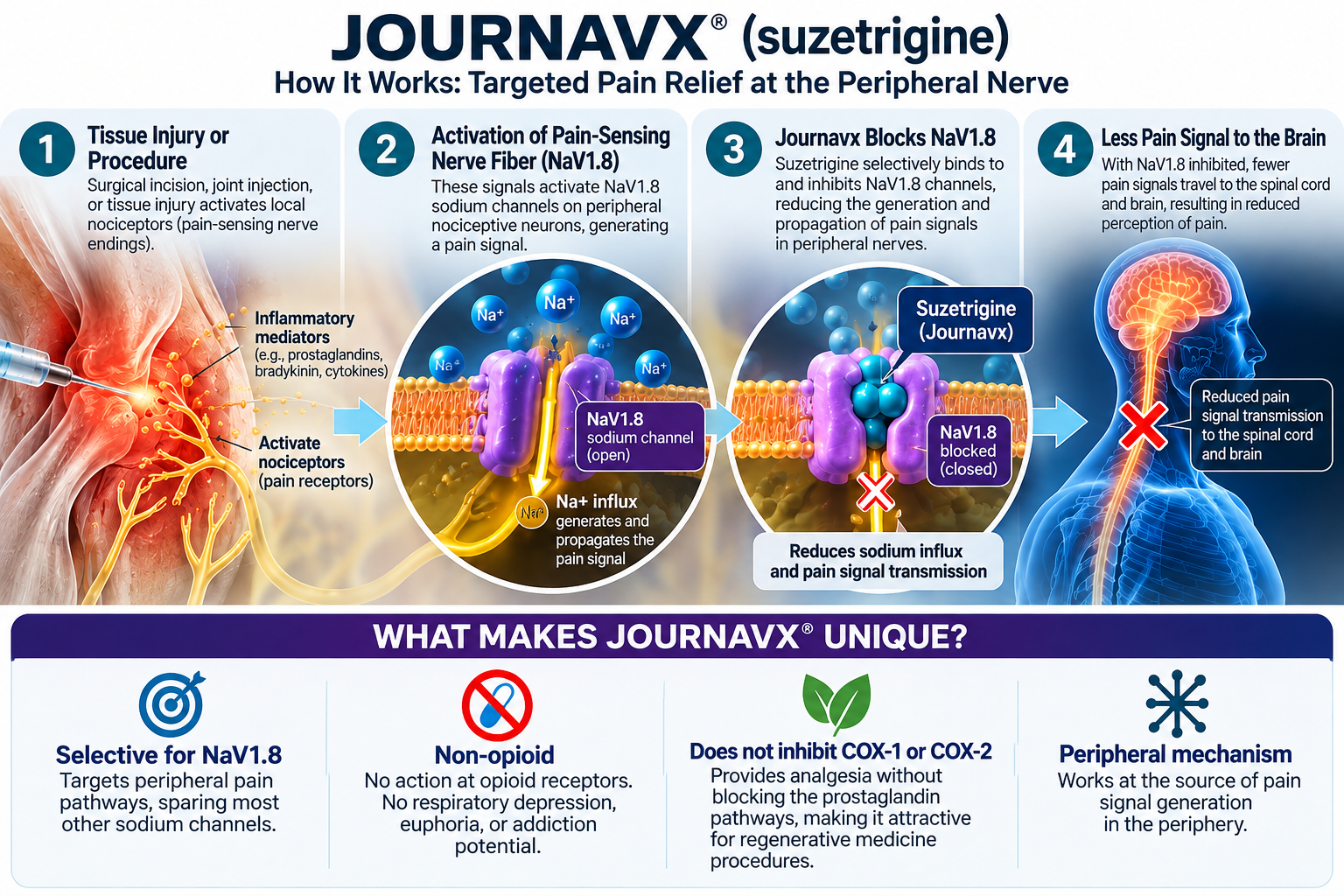
Journavx® (suzetrigine) is the first FDA-approved selective inhibitor of a sodium channel called NaV1.8, a channel that plays an important role in the transmission of pain signals through peripheral sensory nerves.
Instead of suppressing inflammation, suzetrigine targets the electrical signal responsible for transmitting pain.
When tissue is injured—whether through arthritis, tendon injury, surgery, or even the controlled tissue stimulation associated with a regenerative procedure—chemical mediators activate specialized pain-sensing nerve endings called nociceptors.
Those nerves must then generate an electrical signal.
NaV1.8 sodium channels are an important part of that process. When these channels open, sodium enters the nerve cell, helping generate and propagate the electrical impulses that ultimately travel toward the spinal cord and brain.
Suzetrigine selectively inhibits NaV1.8.
The tissue can still generate an inflammatory response. The immune system can still communicate. Prostaglandin pathways are not directly inhibited. But the peripheral nerve has a reduced ability to generate and propagate the pain signal.
In simple terms:
The goal is not to shut down the healing response. It is to turn down the volume of the pain signal.
That distinction is particularly interesting in regenerative medicine.
Journavx also approaches pain without activating opioid receptors. It is not an opioid and does not produce analgesia through the same pathways responsible for opioid-associated euphoria, respiratory depression, physical dependence, and addiction.
Clinical trials in acute postoperative pain demonstrated that suzetrigine can provide meaningful pain relief, leading to FDA approval for moderate-to-severe acute pain in adults. Its mechanism has also generated interest as part of multimodal and opioid-sparing approaches to procedural and surgical pain.
At RegeneZone™, we believe this pharmacology fits particularly well with the philosophy behind regenerative medicine.
For selected patients undergoing image-guided regenerative procedures, we are incorporating suzetrigine before the procedure as part of our approach to procedural pain management.
The objective is simple: provide meaningful pain control while minimizing unnecessary interference with inflammatory pathways that participate in the body's response to tissue injury.
This does not mean inflammation should always be preserved or that every inflammatory response is beneficial. Excessive or chronic inflammation can itself contribute to pain and tissue degeneration. Regenerative medicine requires understanding the difference between pathological inflammation and the carefully orchestrated acute inflammatory response involved in tissue repair.
It is also important to be precise about what we currently know.
Suzetrigine has not been demonstrated to improve PRP, orthobiologic, or regenerative treatment outcomes. It should not be considered a regenerative therapy. Its FDA-approved indication is the treatment of moderate-to-severe acute pain in adults.
Its potential value in regenerative medicine comes from something different: how it controls pain.
Rather than inhibiting COX-1 or COX-2 or activating opioid receptors, suzetrigine selectively targets a peripheral sodium channel involved in nociceptive signaling. That provides physicians with another tool for separating pain control from broad suppression of inflammation.
As regenerative medicine becomes more sophisticated, details like these matter.
The future of the field is not simply about finding increasingly advanced biologics or performing increasingly complex injections. It is about understanding the entire biological environment surrounding the procedure—from patient preparation and metabolic health to image guidance, tissue targeting, rehabilitation, and pain management.
At RegeneZone, that is how we approach regenerative medicine.
Control the pain. Preserve the biology. Support the healing process.
Journavx® (suzetrigine) is FDA-approved for the treatment of moderate-to-severe acute pain in adults. Its use before a regenerative medicine procedure should be determined individually by the treating clinician based on the patient's medical history, medications, contraindications, and potential drug interactions. Current clinical evidence does not establish that suzetrigine enhances tissue regeneration or improves outcomes from PRP or other orthobiologic procedures.