
By Dr. John A. Robinson, NMD | RegeneZone™
When we think about our joints, we typically think about movement. Our knees allow us to walk, our hips support our bodies, and our shoulders provide an extraordinary range of motion. When something goes wrong, our attention turns to arthritis, cartilage degeneration, inflammation, or injury. Yet this mechanical perspective overlooks a fascinating aspect of joint physiology: our joints are biologically active structures that release signaling molecules capable of influencing other cells and tissues.
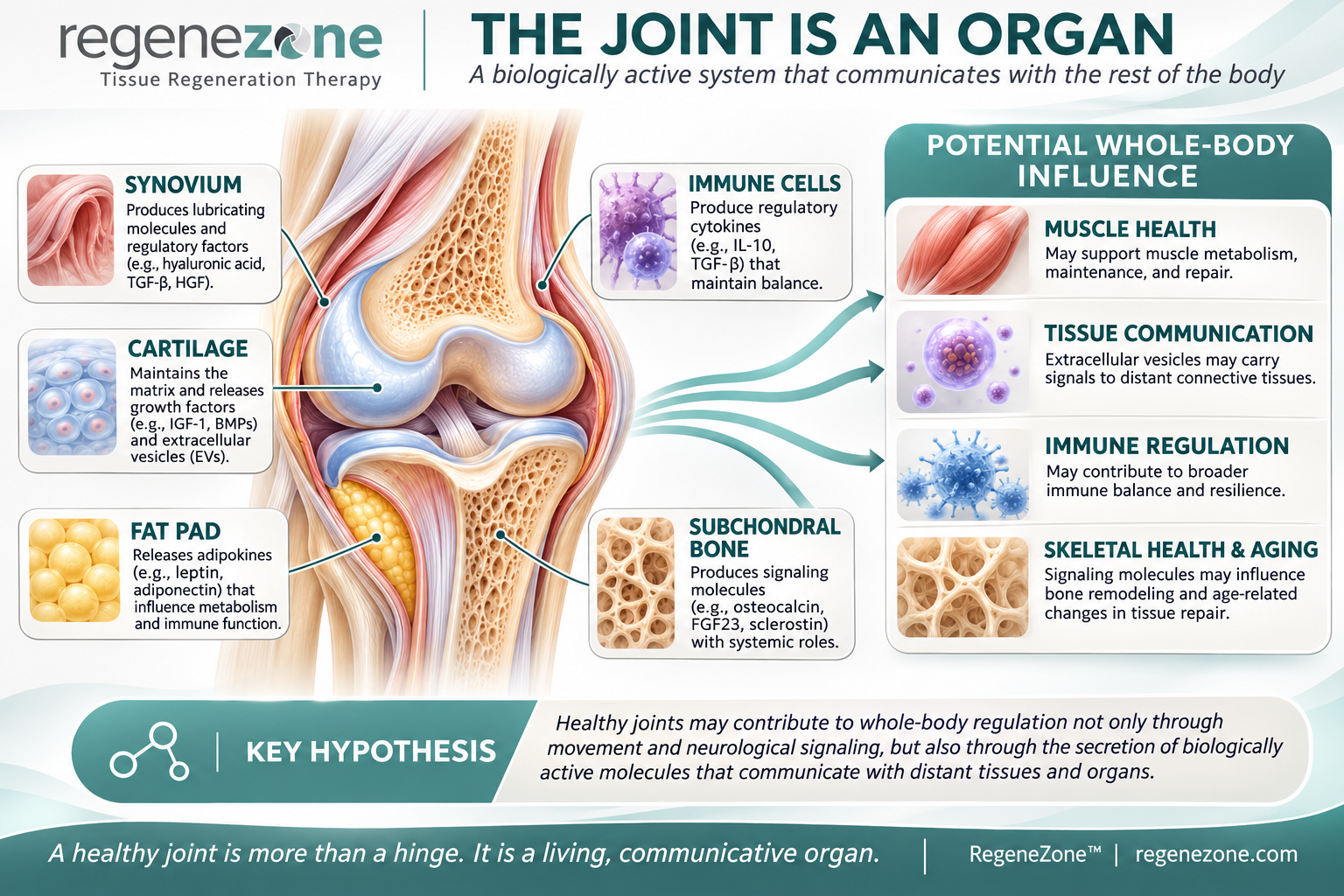
This leads to a hypothesis worth exploring: healthy joints may contribute to whole-body physiological regulation not only through movement and neurological signaling, but also through the secretion of molecules that communicate with distant tissues and organs. If so, preserving joint health may have implications extending beyond mobility, potentially influencing metabolism, immune regulation, tissue repair, and biological aging.
The Joint Is More Than a Mechanical Structure
For decades, osteoarthritis was largely understood as a disease of cartilage deterioration. Today, researchers increasingly recognize the joint as an integrated biological organ. In a landmark 2012 paper published in Arthritis & Rheumatism, Richard Loeser and colleagues described osteoarthritis as a disease of the "joint as an organ," emphasizing that cartilage, subchondral bone, synovium, and surrounding tissues constantly influence one another through mechanical and biochemical signaling.
While this research transformed our understanding of joint disease, it also invites us to consider healthy joint physiology differently. Rather than focusing exclusively on how systemic inflammation, metabolism, and aging affect our joints, we should investigate how healthy joints may influence the rest of the body.
The Joint Secretome: A Biochemical Communication Network
A healthy joint contains metabolically active cells that release growth factors, cytokines, extracellular vesicles (EVs), and other signaling molecules. Collectively, these secretions form what we can describe as the joint secretome, a biochemical network through which joint tissues communicate.
The synovial membrane produces hyaluronic acid and lubricin for lubrication, along with TGF-β, HGF, and cytokines involved in cellular communication and immune regulation. Articular cartilage contains chondrocytes that maintain the extracellular matrix while producing IGF-1, TGF-β, BMPs, and extracellular vesicles that influence neighboring cells.
The infrapatellar fat pad, often regarded as a passive cushion, releases adipokines such as leptin, adiponectin, and resistin, which participate in metabolic and immune signaling. Meanwhile, subchondral bone produces osteocalcin, FGF23, sclerostin, and other regulators of bone metabolism. Some have established systemic functions, particularly FGF23 in phosphate and vitamin D regulation, although the specific contribution of subchondral bone remains uncertain.
Finally, synovial immune cells, including resident macrophages, release regulatory cytokines such as IL-10 and TGF-β that support immune surveillance and tissue homeostasis.
Together, these tissues form a sophisticated secretory environment, demonstrating that the joint is a living biological system engaged in continuous molecular communication.
Could the Joint Be an Endocrine Organ?
Our understanding of the endocrine system has expanded considerably. Skeletal muscle is now recognized as a secretory organ because contracting muscle fibers release myokines that influence metabolism and immune function. Bone produces hormones involved in systemic regulation, while adipose tissue releases adipokines that communicate with the brain, liver, and skeletal muscle.
The joint contains many of these same biologically active tissues, making it reasonable to investigate whether it contributes to systemic endocrine signaling.
Although joint tissues clearly produce signaling molecules, establishing the joint as an independent endocrine organ requires demonstrating that these substances enter circulation in meaningful concentrations and influence distant tissues. Nevertheless, the molecular machinery for such communication is present, providing a compelling foundation for further research.
The Joint Secretome and Whole-Body Communication
The potential systemic influence of the joint secretome becomes particularly interesting when we consider four biological pathways.
Skeletal muscle metabolism and regeneration may represent one connection. Joint-associated tissues produce growth factors and adipokines involved in muscle physiology. IGF-1 supports muscle protein synthesis, adiponectin participates in insulin sensitivity, and osteocalcin has demonstrated effects on muscle metabolism in experimental models. These shared signaling pathways suggest that joint-derived molecules could contribute to muscle maintenance and repair, although their direct systemic contribution remains to be established.
Extracellular vesicles offer another possibility. Chondrocytes, synoviocytes, and bone cells release EVs containing proteins, lipids, and microRNAs that influence recipient cells. Within the joint, these vesicles facilitate communication among cartilage, synovium, and subchondral bone. Because EV-mediated communication between distant organs occurs in other physiological systems, joint-derived vesicles could potentially enter circulation and influence remote connective tissues, extracellular matrix regulation, or repair responses.
Immune regulation provides a third connection. Healthy joints contain macrophages, fibroblasts, and adipose cells that produce cytokines and other immune mediators. Molecules such as IL-10, TGF-β, and adipokines participate in signaling pathways throughout the body, suggesting that joint-associated tissues could contribute to broader immune communication, although their independent systemic influence remains uncertain.
Finally, skeletal remodeling and biological aging may provide another link. Subchondral bone produces osteocalcin, sclerostin, and regulators of the RANKL pathway, which participate in skeletal remodeling. Because aging alters bone turnover, inflammatory regulation, and tissue repair, changes in the joint's secretory profile may reflect or potentially influence broader physiological resilience.
Together, these mechanisms suggest that the joint's biochemical activity may extend beyond local tissue maintenance, opening an important area for future research.
A Different Perspective on Joint Health and Longevity
At RegeneZone™, we approach the joint as a complete biological system, evaluating cartilage, subchondral bone, synovium, ligaments, tendons, biomechanics, inflammation, and metabolic health. This reflects our understanding that joint health involves far more than mechanical wear or isolated structural abnormalities.
Healthy joints allow us to remain physically active, preserve muscle mass, maintain metabolic health, and participate fully in life, all of which have profound implications for healthspan and longevity. Their secretory biology suggests that their physiological importance may extend even further.
If research establishes that healthy joint tissues contribute meaningful biochemical signals to distant organs, maintaining joint health may eventually be understood as part of preserving systemic physiological function, rather than simply preventing pain or disability.
The Future of Joint Medicine
The joint is not merely a mechanical structure that deteriorates with age. It is a living, metabolically active organ engaged in continuous mechanical, neurological, and biochemical communication.
Modern research has established many of these interactions within the joint. The next frontier is determining whether its secretory activity also influences distant tissues and contributes to the biological networks that maintain physiological balance.
Perhaps the most important question in joint medicine isn't simply how we keep our joints healthy. It's also what healthy joints may be doing to help keep the rest of us healthy.
That is a question worth investigating.
Selected Scientific References
Loeser RF, Goldring SR, Scanzello CR, Goldring MB. Osteoarthritis: A Disease of the Joint as an Organ. Arthritis & Rheumatism. 2012;64(6):1697–1707. https://doi.org/10.1002/art.34453
Karsenty G, Olson EN. Bone and Muscle Endocrine Functions: Unexpected Paradigms of Inter-organ Communication. Cell. 2016;164(6):1248–1256. https://doi.org/10.1016/j.cell.2016.02.043
Pedersen BK, Febbraio MA. Muscles, Exercise and Obesity: Skeletal Muscle as a Secretory Organ. Nature Reviews Endocrinology. 2012;8:457–465. https://doi.org/10.1038/nrendo.2012.49
Karsenty G, Ferron M. The Contribution of Bone to Whole-Organism Physiology. Nature. 2012;481:314–320. https://doi.org/10.1038/nature10763
Goldring SR, Goldring MB. Changes in the Osteochondral Unit During Osteoarthritis: Structure, Function and Cartilage–Bone Crosstalk. Nature Reviews Rheumatology. 2016;12:632–644. https://doi.org/10.1038/nrrheum.2016.148
RegeneZone™
Comprehensive Joint Health. Regenerative Medicine. A Whole-Body Perspective.
