By Dr. John A. Robinson, NMD
RegeneZone™
One of the biggest misconceptions I still encounter in medicine is the idea that osteoarthritis is simply a consequence of getting older. Patients are often told that their joints are "wearing out," that cartilage naturally disappears with age, and that eventually their only option may be pain medications, injections, or joint replacement surgery.
After more than 20 years in clinical practice, that has never been how I have viewed osteoarthritis.
While aging certainly plays a role, I believe osteoarthritis is far more complex than simple mechanical wear and tear. Modern research increasingly supports what many of us in regenerative medicine have suspected for years: osteoarthritis is a biologic disease involving chronic inflammation, altered cellular signaling, failed tissue repair, metabolic dysfunction, and changes throughout the entire joint. Understanding this distinction is important because it fundamentally changes how I approach treatment.
The goal should not simply be managing symptoms. The goal should be creating an environment where the body has the greatest opportunity to heal, repair, and restore function.
A Joint Is a Living Organ
When most people think about osteoarthritis, they think about cartilage.
In reality, I view the joint as an entire biologic ecosystem.
A healthy joint consists of cartilage, ligaments, tendons, synovial tissue, bone, blood vessels, nerves, and surrounding muscles that all work together as a functional unit. When one component begins to fail, the entire system is affected.
The research reviewed in the International Journal of Molecular Sciences highlights this concept well. Osteoarthritis is now understood to be a disease involving the entire joint organ, not simply cartilage loss.
This helps explain something I see frequently in practice. Some patients have severe pain despite relatively modest findings on imaging. Others may have significant degeneration visible on MRI yet continue functioning surprisingly well. The answer often lies in the biologic health of the entire joint environment rather than the thickness of the cartilage alone.
Inflammation Is Often the Real Driver
One of the most important developments in osteoarthritis research has been the recognition of chronic inflammation as a major contributor to disease progression.
When I evaluate a patient with arthritis, I am not just looking at structural damage. I am looking at the inflammatory environment surrounding that damage.
Inflammatory signaling molecules such as IL-1β and TNF-α stimulate the production of enzymes that actively degrade cartilage tissue. Over time, these inflammatory pathways create a cycle in which damaged tissue generates more inflammation, which then leads to further tissue breakdown.
The result is progressive degeneration, increasing pain, and declining function.
This is one reason I believe simply suppressing symptoms often falls short. If we do not address the underlying biologic environment, we may temporarily reduce discomfort while the degenerative process continues beneath the surface.
The Problem With Cartilage Healing
Cartilage presents a unique challenge because it has very limited blood flow.
Unlike skin, muscle, or many other tissues in the body, cartilage does not receive a robust supply of nutrients, oxygen, and reparative cells. As a result, its ability to heal after injury is inherently limited.
When cartilage is damaged, the body often attempts a repair response. Unfortunately, that repair tissue is frequently fibrocartilage rather than true hyaline cartilage. Fibrocartilage is mechanically inferior and less capable of handling the demands of normal joint function.
Over time, these imperfect repairs can contribute to continued degeneration.
This is one of the reasons I became interested in regenerative medicine. The question is not simply how we reduce pain. The question is how we can support the body's natural repair processes in a tissue that struggles to heal itself.
Why I Became Interested in Regenerative Orthopedics
Throughout my career, I have always been drawn toward approaches that work with the body rather than against it.
That does not mean conventional medicine lacks value. Physical therapy, exercise, weight management, anti-inflammatory medications, corticosteroid injections, hyaluronic acid injections, and joint replacement surgery all have important roles in appropriate patients.
However, I have always been interested in what lies between conservative care and surgery.
How do we help patients preserve tissue?
How do we improve function?
How do we optimize the biologic environment inside the joint?
How do we support healing before a patient reaches the point of needing a joint replacement?
These questions led me into regenerative medicine and orthobiologics.
The Promise of Cellular Signaling
One of the most fascinating discoveries in regenerative medicine is that healing is often driven by signaling rather than simply replacing tissue.
For many years, stem cells were viewed primarily as replacement cells that would transform into new cartilage or tendon tissue. While that may occur to some extent, the current research suggests that their most important role may be their ability to communicate.
Mesenchymal stem cells release hundreds of biologically active molecules that help regulate inflammation, recruit healing cells, influence immune function, and support tissue repair.
In other words, they help create an environment where healing becomes more likely.
As a clinician, I find this concept incredibly important because it aligns with how I have always viewed medicine. The body possesses remarkable healing potential when given the proper support and conditions.
Why Exosomes Have Generated So Much Interest
Another area of regenerative medicine that I find particularly exciting is the study of exosomes and extracellular vesicles.
These microscopic signaling particles act as biological messengers between cells. They contain proteins, growth factors, messenger RNA, microRNA, and other molecules that influence tissue repair.
Think of them as communication packages that help coordinate healing.
Research suggests that many of the benefits traditionally attributed to stem cells may actually be mediated through these signaling particles. This has led to growing interest in utilizing exosome-based therapies as part of comprehensive regenerative protocols.
While the science continues to evolve, I believe cellular communication represents one of the most important frontiers in regenerative medicine.
My RegeneZone Philosophy
At RegeneZone, I do not view osteoarthritis as simply a cartilage problem.
I view it as a biologic problem.
When I evaluate a patient, I am asking several questions:
What is driving the inflammation?
What tissues are involved?
What biomechanical factors contributed to the injury?
What regenerative capacity remains within the joint?
How can we create the most favorable healing environment possible?
This is why our protocols often combine multiple regenerative strategies rather than relying on a single intervention.
Depending on the patient, that may include:
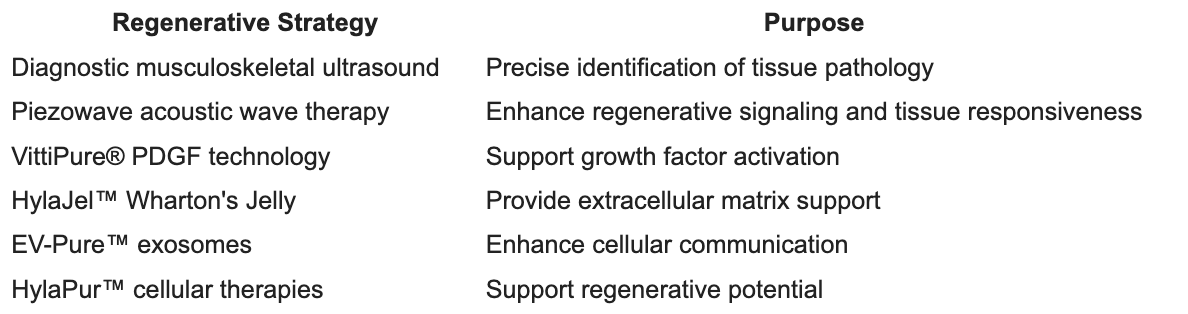
Rehabilitation and movement optimizationImprove long-term functional outcomes
I often describe regenerative medicine as creating the conditions for healing. No therapy can force tissue to regenerate. What we can do is optimize the environment in which healing occurs.
The Future of Osteoarthritis Care
I believe we are entering a new era in orthopedic medicine.
The old model viewed osteoarthritis primarily as an inevitable mechanical process. The emerging model recognizes osteoarthritis as a dynamic biologic condition involving inflammation, cellular dysfunction, altered signaling pathways, and impaired repair mechanisms.
That shift is significant because it opens the door to entirely new treatment strategies.
The future will likely involve increasingly personalized regenerative therapies, targeted biologics, advanced cellular signaling technologies, and a deeper understanding of how tissues heal.
While we still have much to learn, I am encouraged by the direction of the science and by what I see clinically every day.
My Final Thoughts
If there is one thing I hope patients understand, it is that osteoarthritis is not simply a story of joints wearing out.
It is a story of tissues attempting to adapt, repair, and survive in a challenging biologic environment.
My role as a regenerative physician is not merely to suppress symptoms. My goal is to understand the entire picture—the inflammation, the biomechanics, the tissue health, the regenerative potential, and the individual sitting in front of me.
Medicine has always been both an art and a science. The science helps us understand the mechanisms. The art helps us understand the person.
When we bring those two together, we create the opportunity for something far more meaningful than symptom management. We create the opportunity to restore function, preserve mobility, and help people return to the activities that make life worth living.
Source:
International Journal of Molecular Sciences. Review article: Osteoarthritis: Molecular Mechanisms, Cellular Signaling, and Emerging Regenerative Therapeutic Approaches (2026). Published in the MDPI journal International Journal of Molecular Sciences.